
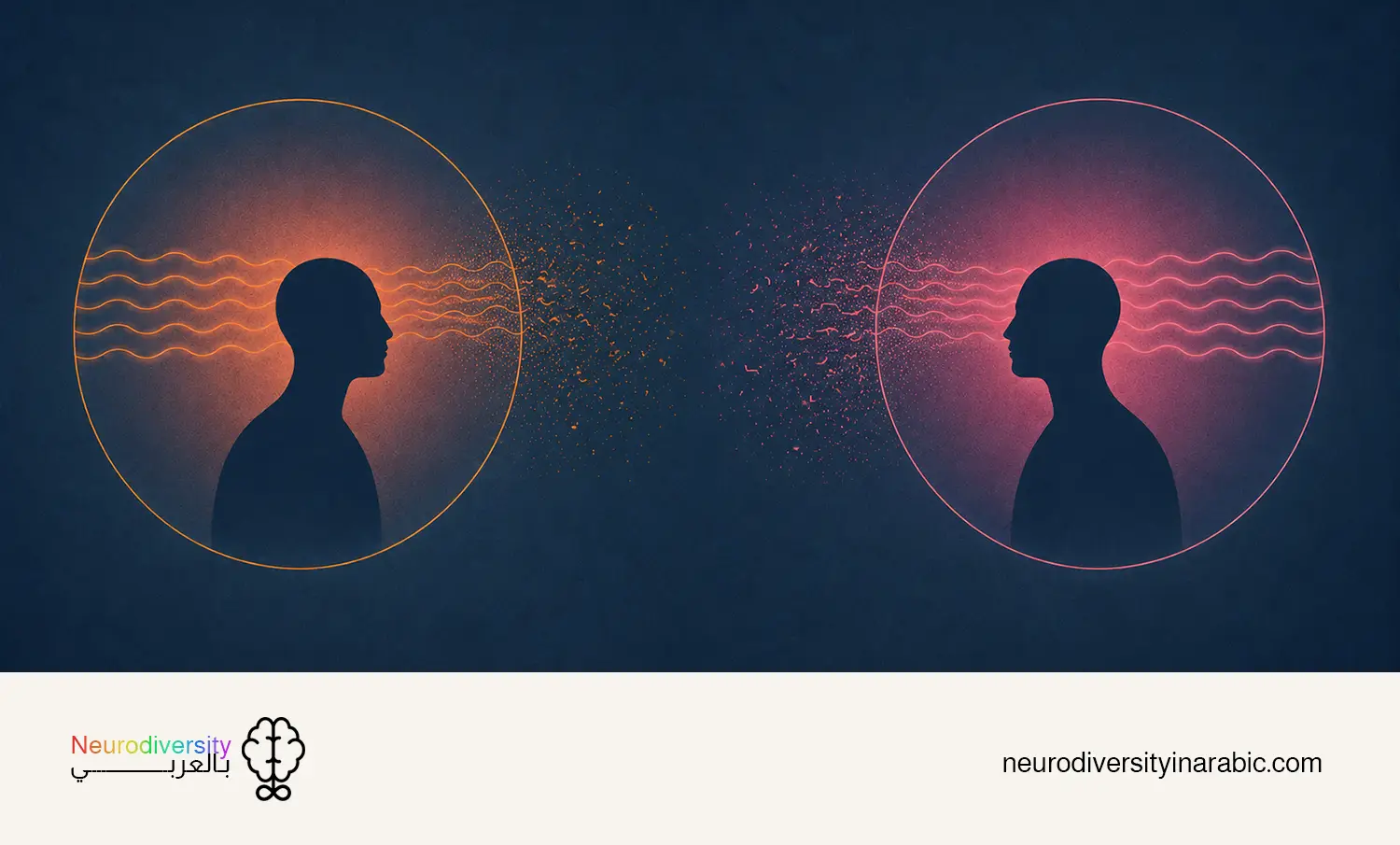

هل المتوحدون فعلاً لا يجيدون التواصل، أم أن النمطيين عصبياً يعجزون أيضاً عن فهم الأنماط العصبية المختلفة عنهم؟
جدول المحتوى
حين نتحدث عن التنوع العصبي، نتحدث عن طيف واسع من الاختلافات في كيفية عمل الدماغ البشري: التوحد، واختلافات النشاط والانتباه، واختلافات التعلم كعسرِ القراءة وعسر الحساب، وغيرها.
هذه الأنماط لا تتشابه في تفاصيلها، لكنها تتشارك تجربة واحدة جوهرية: يشترك أصحابها جميعاً بافتراض واحد سائد عنهم في مجتمعاتهم هو أن ثمّة نمطاً واحداً “طبيعياً” في أسلوب التواصل وطريقة الشعور والتعبير عن الذات، وأن كلّ ما عداه ناقص أو يحتاج إلى تعديل.
من هذا الافتراض الواحد تنبع سلسلة طويلة من النتائج التي يختبرها المتنوعون عصبياً: التصنيف، الوصم، ضغط الشعور بالحاجة لتعديل السلوك، التخفّي والتمويه العصبي، وفي النهاية الإنهاك والمعاناة النفسية.
ولكي نفهم كيف تبدأ هذه السلسلة من الأساس، نحتاج إلى المفهوم الذي كشف الخلل في الافتراض الأول، ونزع عنه قناع “الحياد العلمي”: مشكلة التعاطف المزدوج.
ما هي مشكلة التعاطف المزدوج؟
تم طرح المفهوم على يد عالم الاجتماع البريطاني داميان ميلتون عام 2012، وهو نفسه شخص متوحد يكتب من داخل التجربة لا عنها، ويُعَد من أبرز الأصوات في حقل دراسات التوحد النقدية. صاغ المفهوم في ورقة منشورة في مجلة Disability and Society، وعرّفه بأنه:
انقطاع في التبادل بين فاعلين اجتماعيين مختلفين في تكوينهما، يزداد حدة كلّما اتسعت الفجوة بين تصوّراتهما للعالم –يدركه النمطيون عصبياً باعتباره خرقاً للموقف الطبيعي تجاه ما يعدّ “واقعاً اجتماعياً”، بينما يعيشه المتوحدون كتجربة يومية، صادمة في أحيان كثيرة.
التعريف يبدو بسيطاً للوهلة الأولى، غير أنه في الحقيقة يقلب الفهم السائد رأساً على عقب. ما يقوله لنا ميلتون في هذا الطرح هو أنه حين ينقطع التواصل بين شخص متوحد وشخص نمطي عصبياً، فإن هذا الانقطاع لا يحدث بسبب عجز إدراكي يقع داخل عقل أحدهما، بل ينشأ من وجود فجوة بين المنظورين اللذين يختبر كل منهما العالم من خلالهما.
كلاهما يعجز –بالقدر نفسه– عن قراءة الآخر تلقائياً. والفرق الوحيد بينهما هو أن أحدهما اعتاد أن يعامله المجتمع بوصفه “الطبيعي”، والآخر اعتاد أن يعامله المجتمع بوصفه شخصاً لديه خلل في السلوك يجب تصحيحه وتعديله.
ورغم أن هذا المفهوم نشأ في أبحاث التوحد تحديداً، إلا أن مبدأه الأساسي يمتد ليشمل كل نقطة لقاء بين نمطين عصبيين مختلفين: بين شخص يتميز باختلاف في النشاط والانتباه وزميله النمطي عصبياً في العمل، أو بين طفل لديه اختلافات في التعلّم ومعلّم يتعامل مع المناهج الدراسية وكأنّ لها طريقة وحيدة للاستيعاب.
النشأة: من أين جاءت هذه التسمية؟
لم يُخرِج ميلتون هذا المفهوم من فراغ نظري، ففي كتاباته عن تجاربه المُعاشة، يصف كيف تشكلت الفكرة في داخله انطلاقاً من خبرته المُعاشة كشخص متوحد قضى سنوات يُصنّف “غير اجتماعي” و”بلا تعاطف”، رغم أن إحساسه من داخل ذاته كان أنه يقرأ الآخرين أحياناً بدقّة تفوق قدرتهم على قراءته.
هذه المفارقة بين ما كان يقوله علم النفس الإكلينيكي والنموذج الطبّي عنه، وما كان يعيشه فعلاً في يومه، هي البذرة الأولى التي نمت منها فكرة التعاطف المزدوج.
ولم يكن ميلتون وحيداً في هذه الرحلة. فقد كان جزءاً من جيل من الناشطين والباحثين المتنوعين عصبياً الذين بدأوا منذ تسعينيّات القرن الماضي يطعنون في أُطُر العجز السائدة، ويطرحون أن ما يُسمى “اضطراباً” قد يكون اختلافاً مشروعاً في طريقة عمل الدماغ، له منطقه الداخلي المتماسك.
مفهوم التعاطف المزدوج جاء بوصفه امتداداً لهذه الحركة الفكرية الجماعية، التي صنعها المتنوعون عصبياً لأنفسهم وعن أنفسهم، وليس اكتشافاً فردياً معزولاً.
أما أكاديمياً، فقد استند ميلتون إلى تقاليد سوسيولوجية وفلسفية كانت قد رفضت قبله فكرة أن “الفهم الكامل للآخر” ممكن من الأساس، حتى بين النمطيين عصبياً أنفسهم. يبرز في هذه التقاليد عمل الفيلسوفة النسوية إيريس ماريون يونغ (Iris Marion Young, 1997) عن “التبادل غير المتماثل”، وعمل عالم الاجتماع إرفنغ غوفمان (Erving Goffman,1963) عن الوصم والهوية الاجتماعية.
وحين نضع هذه الفكرة جانباً إلى جانب التعاطف المزدوج، نصل إلى ملاحظة بسيطة لكنها كاشفة: إذا كان لا أحد منا يستطيع فعلاً أن يدرك العالم من داخل عقل آخر تماماً، فإن اشتراط هذا الإدراك على المتنوعين عصبياً وحدهم –كشرط لاعتبارهم “أسوياء”– هو في جوهره موقف سياسي من أقليّة، وليس حقيقة علمية عن طبيعة العقل البشري.
معنى “المزدوج” في الاسم
كلمة “مزدوج” ليست تفصيلاً لغوياً بل قلب للفكرة كلها.
كان التصوّر السائد عن الأشخاص المتوحدين لعقود –مدفوعاً بنظريات مثل “عمى العقل” و”نظرية العقل” التي طُبِقت أيضاً على المتنوعين عصبياً– يفترض أن الانقطاع في التواصل يحدث لأن المتنوع عصبياً ببساطة غير قادر على فهم الآخر النمطي عصبياً.
أي أن المشكلة عجز فردي، يسير في اتجاه واحد، ويستقر داخل معيار واحد للعقل البشري.
ومن هذا التصوّر تشكلت البيئة المعرفية واللغوية كعائق وحاجز معرفي غير مرئي تعايش معه المتنوعون عصبياً لعقود عديدة، استخدم فيها الأطباء والأخصائيون ومقدمو الرعاية والأسرة والمدرسة والمجتمع لغةً ومفاهيم تتعامل مع الاختلاف في التوصيلات العصبية بوصفه خللاً وعجزاً، فأنتجت صورة مشوهة استقرّت في وعي النمطي عصبياً عن المتنوع عصبياً، وفي وعي المتنوع عصبياً عن نفسه.
ومن هنا جاء طرح ميلتون لمشكلة التعاطف المزدوج ليقلب اتجاه السؤال كله. فبدلاً من أن نسأل: “لماذا لا يفهم المتوحد الأشخاص الآخرين؟”، يدعونا أن نسأل سؤالاً مختلفاً تماماً: لماذا نفترض أصلاً أن الخلل وانقطاع التواصل يقع عند طرف واحد فقط؟ ماذا لو كان النمطي عصبياً يعجز بالقدر نفسه عن قراءة المتنوع عصبياً! هل لأن المتنوعين عصبياً يشكلون أقليّة، اعتُبَر عجز الأغلبية في قراءة لغة الآخر وفهم منظوره المعرفي “طبيعياً” بينما اعتُبر عند الأقليّة “اضطراباً” يستدعي التدخل؟
ومن هنا يمكننا ملاحظة الازدواجية التي يحملها الاسم في طياته: فكلا الطرفين يتحرك بأُطُر إدراكية مختلفة، وكلاهما يفشل معاً في قراءة الآخر تلقائياً، ولكل منهما الحق في عالمه الإدراكي الخاص. لكن أحدهما هو الذي يحمل عبء فشل التواصل، ويُطلب منه أن يُعدّل من سلوكه باستمرار، ويُعامَل كأن الخلل يكمن في جهازه العصبي.
الأدلة العلمية: ماذا تقول الأبحاث؟
منذ أن تم طرح المفهوم في عام 2012، تراكمت عليه أدلة تجريبية كثيرة، نستعرض هنا أبرزها:
- دراسة كرومبتون وزملائها (Crompton et al., 2020) اختبرت كيف تنتقل المعلومات في سلاسل من ثمانية أشخاص مشاركين في تجربة شبيهة بلعبة “الهاتف المقطوع”. وجد الباحثون أن المعلومات تنتقل بكفاءة عالية حين تكون سلسلة المشاركين كلها من المتوحدين، وكذلك حين تكون كلها من النمطيين عصبياً، لكنها تتعطل بشكل ملحوظ في السلاسل المختلطة من المشاركين التي تجمع أفراد ذوي أنماطٍ عصبية مختلفة. أي أن المشكلة ليست في طريقة تواصل المتوحدين بحد ذاتها، بل تظهر تحديداً عند نقطة اللقاء بين النمطين.
- هيزمان وغيليسبي (Heasman & Gillespie, 2018) درسا كيف يفهم المتوحدون أنفسهم وعائلاتهم، مقابل كيفية فهم العائلات لهم. كان المتوحدون أكثر دقة في تقدير سوء الفهم بينهم وبين ذويهم، بينما أرجعت العائلات هذا الانقطاع المعرفي إلى “عجز” الشخص المتوحد وحده. أي أن المتنوع عصبياً في هذه التجربة لم يكن عاجزاً عن إدراك الآخر، بل كان أحياناً أكثر إدراكاً للفجوة بينه وبين النمطيين عصبياً من الأشخاص النمطيين أنفسهم.
- وقد صمّم الباحثان نفساهما في دراسة لاحقة (Heasman & Gillespie, 2019) لعبة متاهة تعاونية عبر الإنترنت، شارك فيها 255 شخصاً اعتقدوا أنهم يلعبون مع شريك بشري، بينما كانوا في الحقيقة يلعبون مع شريك اصطناعي مُبرمَج ليتصرف بالطريقة نفسها مع الجميع. قبل بدء اللعبة، قيل لبعض المشاركين إن شريكهم متوحد، ولآخرين إن لديه عسر قراءة، بينما لم تتلقَّ مجموعة ثالثة أي معلومات عنه. وحين عرف المشاركون أن شريكهم متوحد، تحسّن تقييمهم له: رأوه أكثر ذكاءً، ووجدوا معلوماته أكثر فائدة. غير أن النتيجة اللافتة كانت في مكان آخر تماماً: فقد اعتقد هؤلاء المشاركون أنهم قدّموا لشريكهم مساعدة أكبر مما قدّموه فعلاً، إذ لم يرصد الباحثان أي فرق في سلوكهم الحقيقي داخل اللعبة. أطلق الباحثان على هذه الظاهرة اسم “انحياز المساعدة” (helping bias): فالنمطيون عصبياً يبالغون في تقدير مدى مساعدتهم للأشخاص المتوحدين، وهو ما قد يفسّر استمرار المتوحدين في الإبلاغ عن معاملة سلبية حتى ممن هم مقتنعون بأنهم يقدمون الدعم.
- ساسون وزملاؤه (Sasson et al., 2017) أظهروا أن النمطيين عصبياً يكوّنون أحكاماً سلبية عن المتوحدين خلال ثوانٍ من اللقاء، فتنخفض رغبتهم في التفاعل قبل أن يبدأ الحوار من الأساس.
- مراجعات منهجية حديثة (Watts et al., 2025) أكدت أن المتوحدين يصفون لقاءاتهم بمتوحدين آخرين بشعور تفاهم وتقبل وراحة لا يجدونه في لقاءاتهم بغير المتوحدين.
- وفي أبحاث أحدث (Foster et al., 2025؛ Efthimiou et al., 2025) تأكّدَ أن جودة التواصل والمزامنة الحركية بين المشاركين تتحسّن في اللقاءات التي تجمع أشخاصاً من النمط العصبي نفسه، وتتراجع في اللقاءات المختلطة، مما يدعم تجريبياً المبدأ المركزي لمشكلة التعاطف المزدوج.
ما تقوله هذه الأبحاث مجتمعة هو أن انقطاع التواصل ظاهرة علاقاتية تحدث بوصفها نتاجاً للعلاقة بين الأشخاص، وليست عجزاً فردياً، بل هي حالة تنشأ حين لا تتوافق أدوات التواصل بين طرفين في سياق معيّن.
لماذا نحتاج إلى هذه التسمية؟
قد يبدو السؤال نظرياً في الوهلة الأولى، لكنه ليس كذلك. فأن نُسمّي ظاهرة ما يعني أن نعيد توزيع المسؤولية بين أطرافها. وأن نغيّر منظور الناس في أحكامهم اليومية.
قبل أن يدخل مفهوم التعاطف المزدوج إلى الحوار، كان الشخص المتنوع عصبياً –متوحداً كان، أو ذا اختلافات في النشاط والانتباه، أو ذا اختلافات في التعلم– حين يعود من تفاعل اجتماعي مرتبكاً ومستنزفاً، يسمع المحيطَ من حوله يصفه بالجملة ذاتها (هذا الشخص لا يجيد التواصل، وعليه أن يتعلّم).
وكانت العلاجات والتدخلات والمدارس مبنية كلها على فرضية واحدة لم يكن يُشكَّك بها: أن المشكلة في الشخص، وأن الحل هو أن يعدّل سلوكه باستمرار ليشبه الآخرين أكثر فأكثر.
وهنا توجد نقطة كثيراً ما تُهمَل في النقاش. فما تطلبه المجتمعات من المتنوع عصبياً ليس مجرد “تغيير” طفيف، ولا اكتساب مهارة جديدة، بل إعادة برمجة مستمرة لطريقة كلامه، ولحركة جسده، ولنبرة صوته، ولاتجاه نظره، ولإيقاع تفكيره ذاته. هو تعديل سلوك متواصل، يحدث في كل تفاعل تقريباً، طوال اليوم، مدى الحياة.
هذا الفرق بين كلمة “تغيير” التي توحي بطلب بريء وبين مصطلح “تعديل السلوك” الذي يوحي بفرض ثقيل هو الفرق بين كيف يبدو الطلب من الخارج وكيف تُعاش تجربته من الداخل.
من هنا تأتي قيمة تسمية الظاهرة “مزدوجة”، إذ غيرت السؤال الذي يُطرَح من الأساس. فبدلاً من أن نسأل “كيف نعدّل سلوك هذا الشخص ليشبه الأكثرية؟”، صرنا نسأل “كيف نبني جسوراً بين عالمين مختلفين، يحق لكل منهما أن يبقى كما هو؟”. وهذا فرق جوهري، لأنه ينقل اتجاه التدخّل: من تعديل الفرد لينسجم مع البيئة، إلى تعديل البيئة لتتسع تنوعاً بشرياً كان موجوداً فيها منذ البداية.
الأثر الاجتماعي: ما الذي يحدث حينما يسود نمط عصبي واحد؟
هنا تنتقل الفكرة من الإطار النظري، إلى الواقع المُعاش، إلى الحياة اليومية لكل شخص متنوع عصبياً يقرأ هذا الكلام ويعرف عمّا نتحدث.
حين يُقدّم نمط النمطيين عصبياً في التواصل والتعاطف والشعور والتعبير عن الذات بوصفه النمط “الطبيعي” والمعيار العصبي الوحيد – أي بوصفه ما “ينبغي” أن يتصرّف الناس على أساسه– تبدأ سلسلة من النتائج بالتوالي واحدة تلو الأخرى:
- يبدأ التصنيف: يُصنَّف من يخرج عن هذا المعيار بوصفه “ناقصاً” أو “مضطرباً”، حتى حين يفهم نفسه ومحيطه بطريقة متماسكة تماماً من داخله. فالطفل ذو اختلافات النشاط والانتباه يسمع أنه “كسول وقليل تركيز”، والطفل ذو اختلافات التعلّم يسمع أنه “غبي ومُهمِل”، والطفل المتوحد يسمع أنه “بارد وغريب الأطوار”. أحكام لا تعبّر عن هويته، بل تعكس مسافة بينه وبين ما يُتوقع منه أن يكونه.
- يتحول التصنيف إلى وصم اجتماعي. تنتقل العبارة من عيادة الأخصائي إلى الفضاء الاجتماعي لتصبح وصمة تلتصق بالفرد أينما ذهب: لا يجيد التواصل، بارد، عديم التعاطف، غريب، صعب، فاشل. ولا يحتاج الأمر إلى تشخيص رسمي كي تُلصَق به وصمة، فيكفي أن يكون الشخص مختلفاً.
- يبدأ ضغط أساليب تعديل السلوك. يُمارَس على الشخص ضغط دائم ومتعدد المصادر –من الأهل، ومن المدرسة، ومن العمل، ومن مقدمي الرعاية الصحيّة– ليعدّل سلوكه باتجاه المعيار السائد، ليس كاقتراح بل كشرط للقبول والإدماج. والمطلوب منه ليس أن يُغيّر عادة واحدة، بل أن يعيد ضبط نفسه كلها: طريقة مشيه وجلوسه، وحركة يديه، وحدّة صوته، واتجاه نظرته، وحتى ما يُسمح له أن يحبه ويهتم به. هذا هو الفرق الذي يجب أن نلاحظه: المسألة ليست “تغييراً”، بل تعديل سلوك مستمر يطال جوهر الشخص وفرادة هويته العصبية.
- يلجأ الشخص إلى سلوك التخفّي والتمويه العصبي. يبدأ في إخفاء سماته العصبية الأصيلة، ويؤدي طوال الوقت دور شخص نمطي عصبياً لكي يتم قبوله في محيطه: فالشخص المتوحد يفرض على نفسه التواصل البصري المباشر، ويكبت سلوك التحفيز الذاتي المهدئ لجهازهِ العصبي، والشخص ذو اختلافات النشاط والانتباه يستنزف نفسه ليبدو “هادئاً ومنتظماً”، والشخص ذو اختلافات التعلّم يطوّر استراتيجيات إخفاء معقدة كي لا يُكتَشَف اختلافه ويُحرَم من فرصة أو علاقة. هذا الأداء المستمر ليس خياراً حرّاً، بل ثمن يُدفَع مُقابل البقاء في مساحات لم تُصمَّم أصلاً لتتسع له.
- تظهر العواقب النفسية. فقد رصدت الأبحاث على مدار سنوات أن التمويه العصبي طويل الأمد يرتبط ارتباطاً مباشراً بحالة من الإرهاق المزمن تُعرَف بـ”الإنهاك التوحدي”، وبارتفاع معدلات الاكتئاب والقلق، وزيادة معدلات الميول الانتحارية بين البالغين المتنوعين عصبياً (Hull et al., 2017؛ Cage & Troxell-Whitman, 2019؛ Cassidy et al., 2018).
ومن المهم أن ندرك أن هذه ليست سمات للتنوع العصبي ولا أعراضاً مرافقة له، بل هي تحديات تنشأ من بيئته، وتعمل كحاجز غير مرئي يعيق مشاركة المتنوعين عصبياً مشاركة كاملة، فتصبح ثمناً يدفعونه يومياً مقابل إدماجهم في بيئات لم تصمم لتستوعب اختلافهم منذ البداية.
ما الذي نتعلمه؟
الدرس ليس فقط أن “المتنوعين عصبياً يفهمون بعضهم”، رغم أن ذلك صحيح وفيه جمال وراحة لا يجدها المتنوع عصبياً في كثير من علاقاته مع النمطيين عصبياً. الدرس أعمق من ذلك بكثير.
لكي نبدأ رحلة حقيقية في فهم التنوع العصبي –التوحد واختلافات النشاط والانتباه، واختلافات التعلّم، وغيرها– علينا أولاً أن نعترف أن للبشر أنماطاً متعددة في الشعور والتعاطف والتواصل والتعبير عن الذات، وأن هذه الأنماط جميعها مشروعة، وتستحق أن تعامل على أنها أنماط إنسانية أصيلة لها منطقها الداخلي الخاص، وليست انحرافات عن قاعدة واحدة وضعتها الأكثرية كمعيار ثابت.
وهذا لا يعني إلغاء الفروق بين الناس، أو التظاهر بأنها لا تسبب أحياناً سوء فهم حقيقياً. فالفروق قائمة، وانقطاع التواصل وصعوبته عند التقاء أشخاص لديهم توصيلات عصبية مختلفة يحدث، وله تكلفة عاطفية على الطرفين معاً.
لكن القفزة الحقوقية والعلمية التي يدعونا إليها مفهوم التعاطف المزدوج هي أن نتوقف عن تحميل هذه التكلفة لطرف واحد فقط، وأن ندرك أن بناء الفهم بين الناس مسؤولية مشتركة بين كل من يدخل في الحوار، لا واجباً يُفرَض على من يعتبره المجتمع “مختلفاً”.
ويجدر بنا أن ننتبه أيضاً إلى أن ملاحظات هذه الفجوة لا تقف عند أبواب المدارس وأماكن العمل والمؤسسات والمنظومة الطبيّة وحدها، بل تتسرب إلى العلاقات العاطفية، والصداقات، والروابط الأسرية، وإلى كل مساحة يلتقي فيها شخصان مختلفان عصبياً ويحاولان أن يفهما بعضهما.
وقد بدأت الأبحاث الحديثة (Ridout & Hayward, 2019؛ Ghanbari Panah & Mustaffa, 2026) ترصد كيف أن كثيراً مما يُقرَأ في هذه العلاقات بوصفه “برودة” أو “تجنباً عاطفياً” أو “لامبالاة” هو في حقيقته فجوة إدراكية بين نمطين عصبيين، يمكن ردمها بالفهم بدلاً من العتاب، وبتعديل توقعات الطرفين معاً بدلاً من مطالبة أحدهما بتعديل سلوكه وحده، وأن نرى مشكلة التعاطف المزدوج في هذه المساحات تحديداً، يعني أن نمنح الناس –متنوعين عصبياً ونمطيين عصبياً معاً– أدوات تواصل أكثر شمولاً وتبادلاً، تتيح لكل منهما أن يَفهَم ويُفهَم وفق شروطه، فلا تتحول خيبات سوء الفهم في علاقاتهم إلى فشل شخصي يحمله أحدهما وحده.
ولعل أهم ما يمكن أن نخرج به من هذا كله هو أن التغيير الحقيقي يبدأ من اللحظة التي ندرك فيها أن هذه الفجوة موجودة، وأن مسؤولية تجسيرها مشتركة بين النمطيين عصبياً والمتنوعين عصبياً معاً.
فالنمطي عصبياً مدعو إلى أن يدرك أنّ ما اعتاد اعتباره “بديهي” في أساليب التواصل والتعاطف ليس قانوناً عاماً للإنسانية، بل نمط من بين أنماط عديدة أخرى، وأن انقطاع التواصل بينه وبين شخص متنوع عصبياً ليس عجزاً عند الطرف الآخر، بل فجوة معرفية وإدراكية بين الاثنين.
والمتنوع عصبياً مدعو بدوره إلى أن يستعيد فهمه لذاته من منظوره الخاص، وأن يدرك أن ما تشكّل في وعيه على مدى حياته بوصفه “خللاً في توصيلاته العصبية” هو في الحقيقة نصف معادلة، نصفها الآخر كان دائماً عند الطرف النمطي عصبياً الذي لم يحمل يوماً عبء العجز عن التواصل، ولم يُنظَر إليه بوصفه شريكاً في الفجوة الإدراكية والمعرفية بينهما.
ولعل ما يجب أن نقوله بوضوح في الختام هو أن التنوّع العصبي ليس حالة تستدعي “التسامح” أو “الرعاية”، ولا ظاهرة فردية يُكتَفَى بقبولها بوصفها استثناء يجب التعامل معه.
هو شرط بشري أصيل، قائم منذ كان البشر بشراً، يستحق أن نتجاوز فيه خطاب القبول السلبي إلى خطاب أعمق يقوم على التمكين، وعلى إعادة تشكيل البيئات المعرفية واللغوية والاجتماعية والمؤسسية بحيث تستوعب الاختلاف العصبي بوصفه جزءاً طبيعياً من التنوع البشري لا انحرافاً عنه.
ومشكلة التعاطف المزدوج هي المدخل الأول إلى هذا الفهم؛ فحين ندرك أن انقطاع التواصل بين نمطين عصبيين مختلفين هو مسؤولية مشتركة بينهما، نبدأ في بناء بيئات لا تشترط على المتنوع عصبياً إخفاء سمات هويته العصبية أو تعديل سلوكه ليثبت أهليته للقبول، بل تعاد هندستها لتتسع لاختلافه، فتضمن له المشاركة الكاملة في الحياة، شأنه شأن أي إنسان آخر.
——————
من المتنوعين عصبياً إلى المتنوعين عصبياً.
Do autistic people really struggle to communicate — or are neurotypical people equally unable to read neurotypes different from their own?
Introduction
When we speak of neurodiversity, we speak of a wide spectrum of differences in how the human brain works: autism, ADHD, learning differences such as dyslexia and dyscalculia, and others. These neurotypes differ in their details, yet their members share one fundamental experience: a single prevailing assumption held about them in their societies — that there is one “natural” way to communicate, to feel, and to express oneself, and that everything outside it is deficient or in need of correction.
From this single assumption flows a long chain of consequences that neurodivergent people live through: labeling, stigma, the constant pressure to modify one’s behavior, masking and camouflaging, and ultimately burnout and psychological suffering. To understand where this chain begins, we need the concept that exposed the flaw in that first assumption and stripped away its mask of “scientific neutrality”: the double empathy problem.
What Is the Double Empathy Problem?
The concept was introduced in 2012 by the British sociologist Damian Milton — himself an autistic person who writes from within the experience, not merely about it, and one of the most prominent voices in critical autism studies. He coined the term in a paper published in the journal *Disability & Society*, defining it as:
a breakdown in reciprocity between two differently constituted social actors, which grows sharper the wider the gap between their perceptions of the world — experienced by neurotypical people as a breach of what counts as “socially natural,” while autistic people live it as a daily, and often jarring, reality.
The definition may look simple at first glance, but it in fact turns the prevailing understanding on its head. What Milton is telling us is that when communication breaks down between an autistic person and a neurotypical person, the breakdown does not occur because of a cognitive deficit located inside one person’s mind. It arises from a gap between the two perspectives through which each of them experiences the world. Both fail — to an equal degree — to read the other intuitively. The only difference between them is that one has always been treated by society as “the normal one,” while the other has always been treated as someone whose behavior is faulty and must be corrected and modified.
Although the concept emerged specifically within autism research, its core principle extends to every meeting point between two different neurotypes: between a person with ADHD and their neurotypical colleague at work, or between a child with learning differences and a teacher who treats the curriculum as though there were only one way to absorb it.
Origins: Where Did This Name Come From?
Milton did not produce this concept out of a theoretical vacuum. In his writings on his lived experience, he describes how the idea took shape within him as an autistic person who spent years being labeled “asocial” and “lacking empathy” — while his own inner sense was that he sometimes read others with a precision that exceeded their ability to read him. This paradox — between what clinical psychology and the medical model said about him, and what he actually lived each day — was the first seed from which the idea of double empathy grew.
Nor was Milton alone on this journey. He was part of a generation of neurodivergent activists and researchers who, beginning in the 1990s, had been challenging the dominant deficit frameworks and proposing that what gets called a “disorder” may be a legitimate difference in how the brain works, with its own coherent internal logic. The double empathy concept arrived as an extension of this collective intellectual movement — one that neurodivergent people built for themselves and about themselves — not as an isolated individual discovery.
Academically, Milton drew on sociological and philosophical traditions that had already rejected the idea that “complete understanding of another person” is possible at all, even between neurotypical people themselves. Prominent within these traditions is the feminist philosopher Iris Marion Young’s work on “asymmetrical reciprocity” (Iris Marion Young, 1997) and the sociologist Erving Goffman’s work on stigma and social identity (Erving Goffman, 1963).
When we place this idea alongside double empathy, we arrive at a simple but revealing observation: if none of us can truly perceive the world from inside another mind, then demanding this perception from neurodivergent people alone — as a condition for being considered “normal” — is, at its core, a political stance toward a minority, not a scientific truth about the nature of the human mind.
The Meaning of “Double” in the Name
The word “double” is not a linguistic detail — it overturns the entire idea.
For decades, the prevailing view of autistic people — driven by theories such as “mindblindness” and “theory of mind,” which were also applied to other neurodivergent people — assumed that communication breaks down because the neurodivergent person is simply unable to understand the neurotypical other. In other words: the problem is an individual deficit, running in one direction, resting on a single standard for the human mind.
From this view, an entire cognitive and linguistic environment took shape — an invisible barrier that neurodivergent people have lived with for decades, in which doctors, specialists, caregivers, families, schools, and society used language and concepts that treated difference in neurological wiring as a defect and an incapacity. The result was a distorted image that settled both in the neurotypical person’s awareness of the neurodivergent person, and in the neurodivergent person’s awareness of themselves.
This is where Milton’s framing of the double empathy problem reverses the direction of the entire question. Instead of asking, “Why doesn’t the autistic person understand other people?”, he invites us to ask something entirely different: why do we assume in the first place that the fault — the breakdown in communication — lies with one side only? What if the neurotypical person is equally unable to read the neurodivergent one? Is it because neurodivergent people are a minority that the majority’s inability to read the other’s language and grasp their perspective was deemed “natural,” while the minority’s inability was deemed a “disorder” requiring intervention?
Here we can see the doubleness the name carries within it: both parties operate through different perceptual frameworks, both fail together to read the other intuitively, and each has a right to their own perceptual world. Yet only one of them carries the burden of the communication failure, is asked to continuously modify their behavior, and is treated as though the fault lies in their nervous system.
The Scientific Evidence: What Does the Research Say?
Since the concept was introduced in 2012, substantial empirical evidence has accumulated around it. Here are the most significant findings:
A study by Crompton and colleagues (Crompton et al., 2020) tested how information travels through chains of eight participants in an experiment resembling the game of “broken telephone.” The researchers found that information travels with high efficiency when the entire chain consists of autistic people, and equally when it consists entirely of neurotypical people — but it breaks down noticeably in mixed chains that bring together people of different neurotypes. The problem, in other words, is not in how autistic people communicate in itself; it appears precisely at the meeting point between the two neurotypes.
Heasman and Gillespie (Heasman & Gillespie, 2018) examined how autistic people understand themselves and their families, versus how their families understand them. Autistic people were more accurate in estimating the misunderstanding between themselves and their relatives, while families attributed the breakdown to the autistic person’s “deficit” alone. The neurodivergent person in this experiment was not incapable of perceiving the other — they were at times more aware of the gap between themselves and neurotypical people than the neurotypical people were.
In a later experiment, the same researchers used a video game scenario in which neurotypical participants were led to believe they were interacting with another player. When told this player was autistic or had dyslexia, they rated him as less helpful and less useful — even though his behavior had not actually changed. The bias was in the eye of the beholder, not in the neurodivergent person’s conduct.
Sasson and colleagues (Sasson et al., 2017) showed that neurotypical people form negative judgments about autistic people within seconds of meeting them, reducing their willingness to interact before any conversation has even begun.
Recent systematic reviews (Watts et al., 2025) confirmed that autistic people describe their encounters with other autistic people with a sense of mutual understanding, acceptance, and ease that they do not find in encounters with non-autistic people. And newer research (Foster et al., 2025; Efthimiou et al., 2025) confirmed that communication quality and motor synchrony between participants improve in encounters between people of the same neurotype and decline in mixed encounters — empirically supporting the central principle of the double empathy problem.
Taken together, what this research tells us is that communication breakdown is a relational phenomenon — a product of the relationship between people, not an individual deficit. It is a condition that arises when two parties’ communication tools fail to align in a given context.
Why Do We Need This Name?
The question may seem theoretical at first, but it is not. To name a phenomenon is to redistribute responsibility among those involved in it — and to change how people judge one another in daily life.
Before the double empathy concept entered the conversation, a neurodivergent person — autistic, or with ADHD, or with learning differences — would return from a social interaction confused and drained, hearing the people around them repeat the same sentence: this person can’t communicate, and needs to learn how.
Therapies, interventions, and schools were all built on a single unquestioned premise: the problem is in the person, and the solution is for them to keep modifying their behavior to resemble others more and more.
And here lies a point often neglected in the discussion. What societies demand of the neurodivergent person is not a minor “change,” nor the acquisition of a new skill, but a continuous reprogramming of how they speak, how their body moves, the tone of their voice, the direction of their gaze, even the rhythm of their own thinking. It is ongoing behavior modification, occurring in nearly every interaction, all day, for life.
This difference — between the word “change,” which suggests an innocent request, and the term “behavior modification,” which suggests a heavy imposition — is the difference between how the demand looks from the outside and how the experience is lived from within.
This is where the value of naming the phenomenon “double” comes in: it changed the very question being asked. Instead of asking, “How do we modify this person’s behavior so they resemble the majority?”, we began asking, “How do we build bridges between two different worlds, each of which has the right to remain as it is?” This is a fundamental shift, because it redirects the intervention: from adjusting the individual to fit the environment, to adjusting the environment to accommodate a human diversity that was present within it from the beginning.
The Social Impact: What Happens When One Neurotype Dominates?
Here the idea moves from theory into lived reality — into the daily life of every neurodivergent person reading these words and recognizing exactly what we mean.
When the neurotypical mode of communication, empathy, feeling, and self-expression is presented as the “natural” mode and the sole neurological standard — as how people “ought” to behave — a chain of consequences unfolds, one after another:
1. Labeling begins. Whoever departs from this standard is classified as “deficient” or “disordered,” even when they understand themselves and their surroundings in a way that is entirely coherent from within. The child with ADHD hears that they are “lazy and unfocused”; the child with learning differences hears that they are “slow and careless”; the autistic child hears that they are “cold and strange.” Judgments that do not express who the person is, but reflect the distance between them and what they are expected to be.
2. Labeling turns into social stigma. The phrase travels from the specialist’s clinic into social space, becoming a mark that clings to the person wherever they go: can’t communicate, cold, unempathetic, odd, difficult, a failure. No formal diagnosis is needed for the stigma to attach — being different is enough.
3. The pressure of behavior modification begins. The person faces constant pressure from multiple sources — family, school, work, healthcare providers — to adjust their behavior toward the prevailing standard, not as a suggestion but as a condition for acceptance and inclusion. And what is demanded is not changing one habit, but recalibrating their entire self: how they walk and sit, how their hands move, the pitch of their voice, the direction of their gaze, even what they are permitted to love and care about. This is the difference we must notice: it is not a “change” but continuous behavior modification that reaches into the core of the person and the uniqueness of their neurological identity.
4. The person resorts to masking and camouflaging. They begin hiding their authentic neurological traits, performing the role of a neurotypical person around the clock in order to be accepted: the autistic person forces direct eye contact on themselves and suppresses the stimming that soothes their nervous system; the person with ADHD exhausts themselves to appear “calm and organized”; the person with learning differences develops elaborate concealment strategies so their difference is never discovered and never costs them an opportunity or a relationship. This constant performance is not a choice — it is a price paid to remain in spaces that were never designed to hold them.
5. The psychological toll appears. Research has documented over the years that long-term masking is directly linked to a state of chronic exhaustion known as autistic burnout, to elevated rates of depression and anxiety, and to increased suicidality among neurodivergent adults (Hull et al., 2017; Cage & Troxell-Whitman, 2019; Cassidy et al., 2018).
It is essential to understand that these are not traits of neurodivergence, nor symptoms that accompany it. They are challenges that arise from the environment — an invisible barrier blocking neurodivergent people from full participation, a price paid daily in exchange for inclusion in environments never designed to accommodate their difference in the first place.
What Do We Learn?
The lesson is not only that “neurodivergent people understand each other” — though that is true, and there is a beauty and ease in it that neurodivergent people rarely find in many of their relationships with neurotypical people. The lesson runs far deeper.
To begin a genuine journey into understanding neurodiversity — autism, ADHD, learning differences, and beyond — we must first acknowledge that human beings have multiple modes of feeling, empathizing, communicating, and expressing themselves; that all of these modes are legitimate; and that they deserve to be treated as authentic human patterns with their own internal logic, not as deviations from a single rule that the majority set as a fixed standard.
This does not mean erasing differences between people, or pretending they never cause genuine misunderstanding. The differences are real; communication does break down, and struggles do occur, when people with different neurological wiring meet — and it carries an emotional cost for both sides. But the scientific and rights-based leap that the double empathy concept invites us to make is to stop placing that cost on one side alone, and to recognize that building understanding between people is a shared responsibility of everyone who enters the conversation — not a duty imposed on whomever society deems “different.”
We should also notice that this gap does not stop at the doors of schools, workplaces, institutions, and the medical system. It seeps into romantic relationships, friendships, family bonds — into every space where two neurologically different people meet and try to understand each other. Recent research (Ridout & Hayward, 2019; Ghanbari Panah & Mustaffa, 2026) has begun documenting how much of what gets read in these relationships as “coldness,” “emotional avoidance,” or “indifference” is in truth a perceptual gap between two neurotypes — one that can be bridged with understanding instead of blame, and by adjusting both parties’ expectations rather than demanding that one of them alone modify their behavior. To see the double empathy problem in these spaces, specifically, is to give people — neurodivergent and neurotypical alike — more inclusive, more reciprocal tools of communication that allow each to understand and be understood on their own terms, so that the disappointments of misunderstanding in their relationships do not turn into a personal failure carried by one of them alone.
Perhaps the most important thing we can take from all of this is that real change begins the moment we recognize that this gap exists — and that the responsibility for bridging it is shared between neurotypical and neurodivergent people together.
The neurotypical person is invited to recognize that what they have always considered “self-evident” in communication and empathy is not a universal law of humanity, but one mode among many others — and that a communication breakdown between them and a neurodivergent person is not a deficit on the other side, but a cognitive and perceptual gap between the two.
The neurodivergent person, in turn, is invited to reclaim their understanding of themselves from their own perspective — to recognize that what took shape in their awareness over a lifetime as “a fault in their neurological wiring” is in truth half of an equation, whose other half always lay with the neurotypical side that never once carried the burden of the communication failure, and was never seen as a partner in the perceptual and cognitive gap between them.
What must be said clearly, in closing, is that neurodiversity is not a condition calling for “tolerance” or “care,” nor an individual phenomenon to be merely accepted as an exception to be managed. It is an authentic human condition, present for as long as humans have been human — one that deserves that we move beyond the language of passive acceptance toward a deeper language built on empowerment, and on reshaping our cognitive, linguistic, social, and institutional environments so that neurological difference is embraced as a natural part of human diversity, not a deviation from it.
The double empathy problem is the first doorway into this understanding. When we recognize that a communication breakdown between two different neurotypes is a shared responsibility between them, we begin building environments that do not require the neurodivergent person to hide the traits of their neurological identity or modify their behavior to prove they deserve acceptance — environments re-engineered to make room for their difference, guaranteeing them full participation in life, like any other human being.
——————
By neurodivergents, for neurodivergents.
مصادر
مشاركة على المنصة
إذا كنت ترغب بمشاركة مقال على المنصة، يرجى التواصل عبر البريد الإلكتروني:
allies@neurodiversityinarabic.comIf you would like to share an article to the platform, please contact us by email:
allies@neurodiversityinarabic.comمصادر
مشاركة على المنصة
إذا كنت ترغب بمشاركة مقال على المنصة، يرجى التواصل عبر البريد الإلكتروني:
allies@neurodiversityinarabic.comIf you would like to share an article to the platform, please contact us by email:
allies@neurodiversityinarabic.com